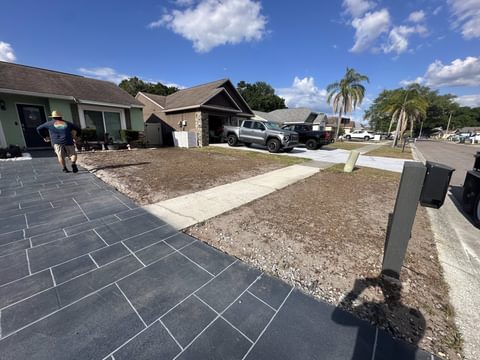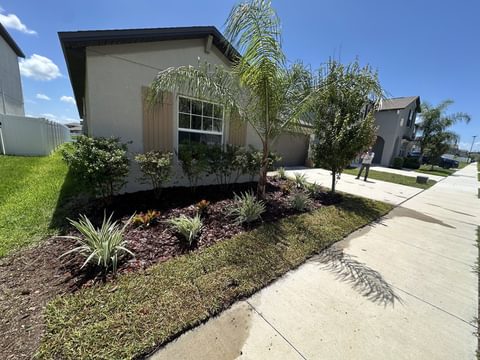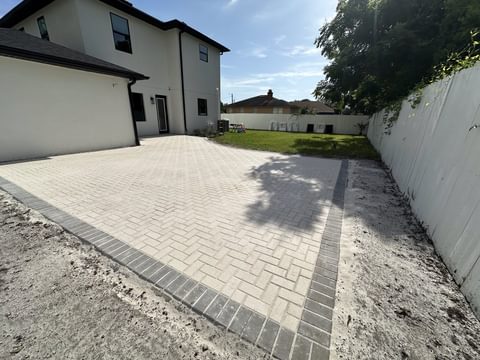
Short answer: a paver project goes right when four things are settled before anyone digs: how the space will be used, where the water will drain, what goes under the pavers, and which permits and HOA approvals apply. Here's how to work through each one for Tampa Bay's sandy soil and summer storms.
What should I decide first?
Settle the basics before you pick a color:
- Use and size. A patio for a table and grill is a different build from a driveway for two cars. Vehicle traffic calls for thicker pavers and a deeper base.
- Slope. Hardscape should fall 1–2% away from the house, roughly ⅛ to ¼ inch per foot, so water never runs toward the foundation.
- Trees and roots. Big roots lift pavers over time. In the City of Tampa, specimen trees 24 inches or more in trunk diameter get a 15-foot protective distance on driveway plans.
- Utilities. Florida law requires a call to Sunshine 811 two full business days before digging, and the marks are good for 30 days.
- Pattern and color. Herringbone is a common driveway pattern because the interlock resists shifting under tires, but it means more cuts at the edges. Borders and curves add work too.
Which paver material fits?
Concrete pavers
Concrete pavers are the most common choice, with the widest range of colors, shapes and patterns. Quality units meet ASTM C936, which calls for an average compressive strength of at least 8,000 psi and average absorption of no more than 5%. A 2⅜-inch (60 mm) paver works for patios and residential driveways; 3⅛-inch (80 mm) pavers are for heavier vehicles.
Clay brick
Clay brick pavers are kiln-fired, and suppliers note that the color runs through the whole unit instead of sitting on the surface. They give walkways and courtyards a classic look. Ask how a specific product holds its color in full sun.
Travertine
Natural travertine is a favorite around pools, and light colors stay cooler underfoot. Ask your supplier about sealing it against stains before you choose.
What about permeable pavers?
Standard pavers with sand-filled joints aren't permeable pavement. True permeable interlocking concrete pavement is a different build, with open joints and an open-graded stone base, so ask for it by name if your site needs it.
What goes under the pavers?
The base does the real work, and Tampa Bay's soil makes it matter even more. Local Myakka-type sands hold the water table within about 18 inches of the surface for one to four months in most years, over a hardpan 20–36 inches down. Industry guidance from ICPI Tech Spec 2 and paver manufacturers calls for:
- 4–6 inches of compacted aggregate base under patios and walkways.
- 6–8 inches or more under driveways; some manufacturers specify 8–12.
- Compaction in 2–4-inch lifts to 98% of standard Proctor density.
- About 1 inch of concrete sand for bedding, never stone dust or masonry sand.
- On many sites, geotextile fabric between the native sand and the base to keep fine sand from migrating into it.
A thin or poorly compacted base is what usually shows up later as sunken spots and ruts.
How are the edges and joints finished?
Edge restraint keeps the paver field from creeping apart: a concrete curb or bond beam, or a spiked PVC or aluminum restraint. The joints are filled with sand and compacted. Polymeric sand is popular because it firms up and resists washout, but it has to cure dry, so from June through September it's best scheduled around the afternoon storms.
Do I need a permit or HOA approval?
For driveways, often yes. The rules follow where your property sits, not just the city on your mailing address:
- City of Tampa: a residential driveway permit. The plan shows property lines, the right-of-way and every tree within 20 feet, and may need a paver edge detail. An apron in the right-of-way needs a City right-of-way permit.
- Unincorporated Hillsborough: a Driveway Access (right-of-way) permit to connect to a county road. Homeowners or contractors can apply.
- Clearwater: a dedicated “Brick Paver Driveway” right-of-way permit.
- St. Petersburg: flatwork no more than 12 inches above grade is exempt from a building permit, though setbacks still apply and historic districts can differ. A driveway apron needs an Engineering right-of-way permit.
- Unincorporated Pinellas: pavers need zoning clearance, and a new or extended driveway also needs tree/habitat and right-of-way permits.
- Pasco County: a right-of-way use permit that includes the paver manufacturer's specs.
- Patios: many don't need a building permit, but setbacks, easements and HOA rules still apply. Check with your city or county.
- HOAs: most require architectural approval for pavers. Get it in writing before materials are ordered.
- Large sites: a state Environmental Resource Permit is generally required above 4,000 square feet of vehicle surface or 9,000 square feet of total impervious area, and for any work in wetlands.
Florida's HB 735 (2021) stopped local governments from requiring a special license just for driveway installation or decorative stone, but permits still apply. We point out what applies to your address during the estimate; approval is up to the city, county or HOA.
How do I care for pavers?
- Sweep or blow them off regularly, and rinse stains early.
- Refill joints when the sand washes out; weeds and ants are the sign.
- Sealing is optional. It deepens color and helps resist stains, and many manufacturers suggest waiting until any white haze (efflorescence) fades. Check your paver brand's care guide.
- Fix sunken spots early. Pavers can be lifted, re-bedded and relaid, which is a big advantage over a slab.
Pavers or poured concrete?
A quick comparison for patios and driveways:
- Cracking: pavers flex at the joints; a slab cracks where it wants to.
- Repairs: pavers lift out and go back in; slab repairs are patches or full replacement.
- Looks: pavers offer colors, patterns and borders; concrete is plain or stamped.
- Upkeep: pavers need joint sand and optional sealing; slabs need crack and joint repair.
- Drainage: neither one solves drainage on its own, so both need the right slope.
Do pavers add value?
Realtors think so. In the 2023 Remodeling Impact report from the National Association of Realtors and the National Association of Landscape Professionals (NALP), Realtors estimated that a new patio recovers about 95% of its cost at sale. That's an estimate, not a promise, but it shows that buyers notice outdoor living space.
Ready to plan yours? See our paver installation and site preparation services, then book a free estimate. We build patios, walkways and driveways in Tampa, St. Petersburg, Clearwater and across Tampa Bay.