Free estimates · Hablamos Español · Serving all of Tampa Bay
Randoms Lawn Care & Hardscaping · Home

Storm Services

Storm & disaster cleanup in Tampa Bay, safely and quickly

After a storm, the yard is a safety problem before it's a cleanup job. Broken limbs hang in the canopy, trees lean on fences under tension, debris hides downed wires, and county curbside pickup can take months to reach your street. After Hurricane Milton, Pinellas County finished its final debris pass in unincorporated areas in mid-January 2025, about three months later.

  • 5.0 Google
  • Licensed & Insured
  • 5+ Years
  • Free Estimates
  • Hablamos Español

Overview

Randoms provides rapid-response storm cleanup during business hours, Monday through Saturday, for homes and commercial properties across Tampa Bay. We start with whatever blocks your roof, driveway and doors, cut and clear fallen limbs and trees from the ground, sort debris for county pickup or haul it away, then restore the lawn, beds and mulch. Trees on power lines are the utility's job, never ours.

What's included

  • Safety walk and insurance photos before any cutting
  • Fallen limbs and trees cut and cleared from the ground
  • Broken hanging limbs removed where they can be reached safely
  • Driveway, entry and fence-line clearing first
  • Debris sorted into county categories, or hauled away entirely
  • Stump grinding for trees that came down
  • Lawn, bed and mulch restoration, including silt cleanup
  • Coordination after the utility clears any lines

Safety comes first

Treat every downed wire as live, even when the power is out, and report it to your utility; TECO and Duke Energy both take outage and line reports. Only qualified line-clearance crews should touch a tree that's on or near a power line. Portable generators add a hidden danger: one feeding back into house wiring without a proper transfer switch can energize lines that crews believe are dead.

Then there are the hazards that look harmless. A broken limb hanging in the canopy can drop without warning, and a trunk pinned under another tree can whip loose when it's cut, because it's loaded like a spring. Those cuts belong to people who do them regularly. Our crew walks the property before anyone starts a saw, decides what's safe to cut from the ground and in what order, and leaves anything that isn't.
Who is responsible for a fallen tree

In Hillsborough County, a tree that falls on private property and isn't blocking a public road or power lines is the property owner's to remove. Trees blocking roads go to the city or county, and anything tangled in lines goes to the utility. That first group covers most backyard storm damage: limbs across a driveway, a laurel oak on the back fence, a palm through a pool cage.

Storm damage doesn't automatically cancel tree rules. A damaged tree that's still standing may still need a removal permit where the city or county protects trees of its size. Under Florida Statute 163.045, you can remove a tree on a single-family lot without a local permit if you have signed documentation from your own ISA-certified arborist or a Florida-licensed landscape architect (Randoms doesn't provide these assessments) showing it poses an unacceptable risk. We work from that report, and we check with the city or county when a damaged tree is protected.

Curbside pickup or full haul-off

If you're using county or city pickup, sorting matters. FEMA guidance divides storm debris into six piles: vegetative debris, construction and demolition debris, appliances, electronics, household hazardous waste and normal garbage. Piles go at the curb, clear of trees, poles, hydrants and meters, and never in the road; Tampa asks for three feet of clearance from obstructions. Hillsborough crews pick up loose piles, not bagged debris or material left on the lawn. Our hurricane-season checklist keeps these sorting rules on one printable page.

There's a catch with hiring help: debris cut by a contractor often isn't eligible for curbside collection, so check your city's rules. We haul what we cut. Full haul-off also makes sense when you don't want a pile out front for weeks. After Helene and Milton, Hillsborough warned that collection could take months, and the county expected roughly five million cubic yards of debris.

Restoring the lawn and beds

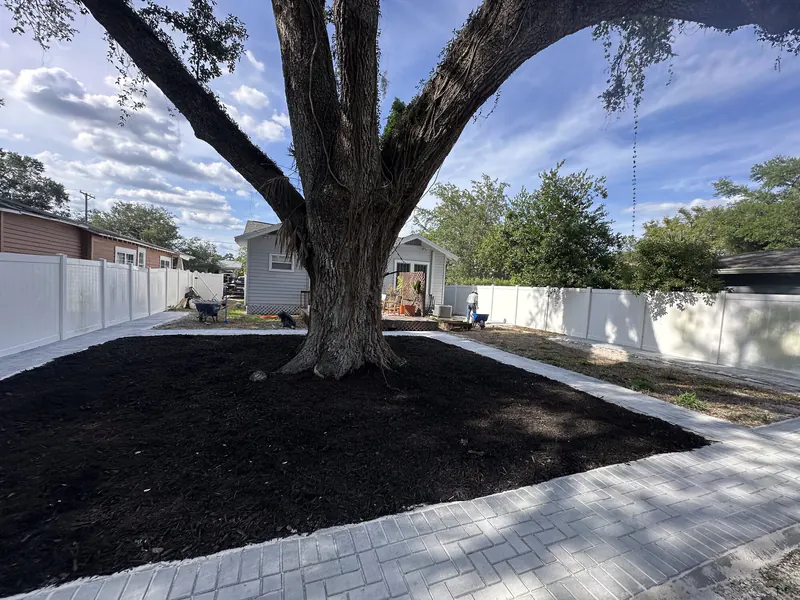
Once debris is gone, the yard usually shows its real damage: ruts from fallen trunks, crushed shrubs, mulch washed into the lawn, dead patches where limbs sat for days. We grind the stumps of trees that came down through our stump grinding service, regrade the ruts, re-edge beds and replace mulch, and patch or re-sod turf that won't come back.

Coastal yards face one more problem. Where surge or flooding brings saltwater into a yard, a real risk in surge-exposed waterfront areas like Apollo Beach, UF/IFAS advises removing silt and debris right away and flushing the soil with fresh water, using gypsum only on soils confirmed to be sodic, and aerating compacted areas. Salt-burned plants can look worse before they recover, so it often pays to wait a few weeks before replacing anything that might still come back.

Insurance, FEMA and fair pricing

Be careful with promises about who pays. FEMA public assistance covers debris on public property; removing a tree from your own yard is a matter between you and your homeowner's insurance, and coverage varies by policy. We can't tell you what your insurer will pay, but we can give you before-and-after photos and a written estimate that describe the work clearly.

Pricing after a storm should look like pricing before one. During a declared state of emergency, Florida Statute 501.160 prohibits charging prices that are grossly out of line with the prior 30 days for essential goods and services. Our estimates are written before work starts and based on the same factors we use all year. And once your yard is back in shape, our hurricane preparation visit can make the next storm less work.

How it works

Storm & disaster cleanup, step by step

  1. Step 1: Safety check and photos

    We walk the property, document damage and set priorities: roof, driveway and doors first.

  2. Step 2: Cut, clear, sort or haul

    Fallen wood is cut from the ground and either sorted for county pickup or hauled away.

  3. Step 3: Restore the yard

    Stumps ground, ruts leveled, beds re-edged and mulched, damaged turf patched or re-sodded.

  4. Step 4: Prep for the next storm

    We note weak trees and loose items so the next season starts with a plan.

Service areas

Where we offer storm & disaster cleanup

All service areas

Frequently asked questions

Questions about storm & disaster cleanup

More questions? See all FAQs

In Hillsborough County, the property owner does, as long as the tree isn't blocking a public road or tangled in power lines. Trees blocking roads are handled by the city or county, and anything on lines goes to the utility. If a damaged tree is still standing and protected by size, check with your city or county before removing it.

Separate it into the six FEMA categories: vegetative debris, construction and demolition debris, appliances, electronics, household hazardous waste and normal garbage. Stack each pile at the curb, clear of trees, poles, hydrants and meters, and keep everything out of the road. In Tampa, leave three feet of clearance from obstructions. Hillsborough crews take loose piles, not bagged debris.

Often not. Many cities treat debris generated by a hired contractor as the contractor's responsibility, so it may not qualify for curbside collection; check your city's current rules. When Randoms cuts it, we haul it to the proper facility, so you aren't left with a pile the county won't take.

No. Treat the line as live and call your utility, such as TECO or Duke Energy; only qualified line-clearance crews should work on a tree touching or near power lines. Once the utility has cleared the line and confirmed it's safe, we can cut up the rest of the tree, grind the stump and clean up the yard.

Generally not. FEMA public assistance covers debris removal on public property. Clearing trees from your own yard usually falls to you and your homeowner's insurance, and what's covered depends on your policy. We can provide dated photos and a written estimate for your claim, but we can't promise any reimbursement.

We offer rapid response during business hours, Monday through Saturday, and we schedule by safety and access first: trees on roofs, blocked driveways and entries. After a major storm, demand across Tampa Bay is heavy, so we'll give you a clear arrival window when you call or text rather than a promise we can't keep.

Free Estimates

Get your free estimate

Rapid-response cleanup of fallen limbs and storm debris, then lawn and bed restoration.

If we miss your call, we'll text you back from this number during business hours. Msg & data rates may apply; reply STOP to opt out.

Free Estimates · Hablamos Español

Ready to start your project?

Tell us about the yard. We'll recommend the right fix and put it in a free written estimate.

Call or text (813) 359-9722 · Mon–Sat 8:30 AM – 7:00 PM · Sun closed