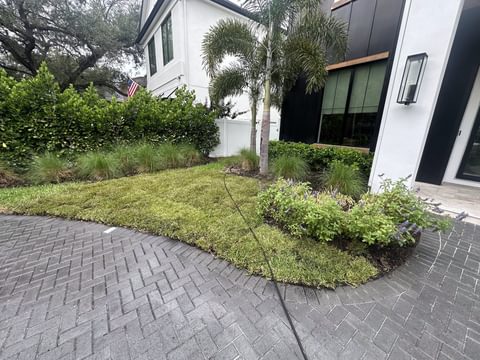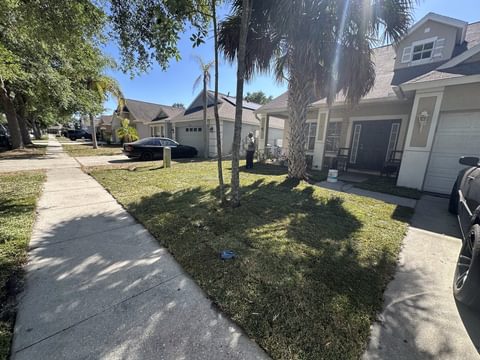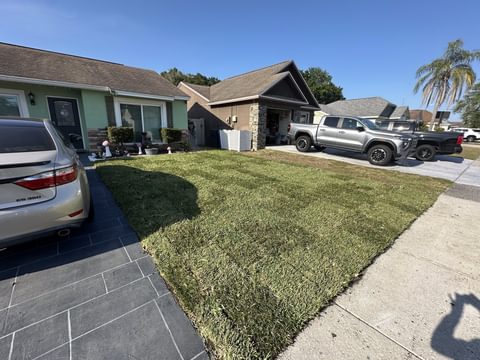
Short answer: for a sunny Tampa Bay yard with irrigation, Floratam St. Augustine is the standard choice. In part shade, pick a shade-tolerant St. Augustine such as CitraBlue, Palmetto or Seville, or a zoysia. If you want the least water and upkeep and can live with a coarser look, choose Bahia. The right sod comes down to three things: sun hours, irrigation and how much care you want to give it.
Which sod is best for Tampa Bay?
Most Tampa Bay lawns are St. Augustine, and for good reason: it handles heat, humidity and sandy soil, and it's widely available. St. Augustine and Bahia make up most of Florida's sod. UF/IFAS counted about 31,900 acres in 2025, 44% of it St. Augustine and 38% Bahia, with zoysia at 9%. Quick picks:
- Full sun (6+ hours), irrigated: Floratam St. Augustine.
- Part shade: CitraBlue, Palmetto or Seville St. Augustine, or a shade-tolerant zoysia such as JaMur.
- Low water, low upkeep, larger lots: Argentine Bahia.
- Full sun and heavy wear, mowed short: Bermuda, if you're ready for more maintenance.
How do I choose the right grass?
Start with the conditions you can't change, then match the grass to them.
Count your sun hours
Floratam needs at least six hours of direct sun. Watch your yard through a full day: live oaks, two-story homes and privacy fences cast long shadows, especially in winter. Strips that only get morning sun are shade-grass territory.
Be honest about irrigation
Our dry season runs roughly October through May. St. Augustine and zoysia need irrigation to stay green through it. Bahia goes dormant in drought and greens up again when the rain returns, which makes it the best fit for yards without a sprinkler system.
Think about salt, wear and pests
Near the water, salt matters. Zoysia and St. Augustine tolerate salt reasonably well, but Bahia's salt tolerance is very poor, so skip it on bayfront lots like many in Apollo Beach. If kids and dogs run the yard, zoysia and Bermuda recover from wear better than St. Augustine.
Decide how much upkeep you want
Zoysia and Bermuda look best mowed low and often. Bahia is mowed tall and needs little feeding, but it sends up seedheads all summer.
What should I know about St. Augustine?
St. Augustine is coarse-bladed, thick and quick to establish, and it's the most common lawn grass in the region.
Floratam
Floratam is the full-sun workhorse. Mow it at 3.5–4 inches. It has poor shade and cold tolerance. It was released in 1973 as resistant to chinch bugs, and the bugs overcame that resistance within about 12 years.
Shade-tolerant cultivars
CitraBlue, developed at UF, has very good shade tolerance and handles drought better than Floratam; mow it at 2–3 inches. Palmetto, Seville and Bitterblue are other shade-tolerant choices. Seville is cold-sensitive, and dwarf types are mowed at about 2.5 inches.
Chinch bugs
The southern chinch bug is St. Augustine's top pest. Damage starts on hot, dry edges along driveways and sidewalks and usually peaks in early July. A coffee-can flotation test confirms it. Treatment is a job for a licensed pest-control applicator, and we can coordinate one for you.
Is zoysia a good choice in Tampa Bay?
Yes, if you want a dense, carpet-like lawn and will keep up with it. Empire is the most common zoysia in Florida (mow at 1.75–2.5 inches). JaMur handles moderate shade, and CitraZoy has the best winter color, with no large patch observed in UF trials. UF calls Zeon “not well adapted to Florida.”
Large patch and thatch
Zoysia's main problem is large patch, a fungal disease that's active from fall to spring, when soil 4 inches down is 65–75°F. Extra nitrogen in spring and fall makes it worse. Zoysia also builds up thatch, and it browns about a week into a drought before greening up again once it's watered.
When does Bahia make sense?
Bahia is the low-input lawn. It has excellent drought and nematode tolerance and needs the least fertilizer. The trade-offs: a coarser, more open look, tall seedheads in summer, mole crickets and yellowing on high-pH fill soil. Argentine is the variety most often used for home lawns. Mow it at 3–4 inches, and keep weed-and-feed products containing atrazine or metsulfuron away from it.
What about Bermuda?
Bermuda is built for full sun and heavy traffic, like sports fields. It needs frequent, low mowing (0.5–1.5 inches), and it has poor shade and nematode tolerance. For most homes, St. Augustine or zoysia is easier to live with.
How do the grasses compare?
From UF/IFAS turfgrass selection guidance (shade ratings vary by cultivar):
- St. Augustine: mow 2–4 in. · shade: good to excellent · drought: good · salt: good · nematodes: good · upkeep: medium.
- Zoysia: mow 1.75–2.5 in. (Empire) · shade: good to excellent · drought: excellent · salt: good · nematodes: good · upkeep: medium.
- Bahia: mow 3–4 in. · shade: fair · drought: excellent · salt: very poor · nematodes: excellent · upkeep: low.
- Bermuda: mow 0.5–1.5 in. · shade: poor · drought: excellent · salt: good · nematodes: poor · upkeep: medium to high.
Can I install sod during the water shortage?
Yes. As of October 2026, the Southwest Florida Water Management District (SWFWMD) Modified Phase III order limits established lawns to one watering day a week through March 31, 2027, but new sod gets a 60-day establishment window:
- Days 1–30: water on any day, within your allowed hours.
- Days 31–60: water three days a week (even addresses Tuesday, Thursday and Sunday; odd addresses Monday, Wednesday and Saturday), and keep a written schedule.
- Pinellas County Utilities customers submit proof of new sod online, a zone may run only if at least half of it is new, and the county advises against re-sodding during the drought.
- St. Petersburg requires a 30-day variance for new sod.
- Pasco County prints its own schedule for days 31–60, so check the county's page.
- Tampa asks you to keep your sod receipts.
Our watering rules guide lists the days and hours for each area. For the first 10 days, water in short cycles to keep the sod moist; then cut back to about once a day, and after three weeks or so, to two or three times a week. Wait at least 30 days before fertilizing new sod.
Why does new sod fail?
Most failures trace back to a handful of causes:
- Floratam laid in shade.
- Compacted soil or high-pH fill under the sod.
- Sod laid over old grass and weeds instead of bare, graded soil.
- Pallets left sitting in the heat. In summer a pallet lasts less than 48 hours, so it should go down the day it arrives.
- Too little water in the first weeks, or too much once it has rooted.
- Chinch bugs or nematodes moving into stressed turf.
When we install sod, we check sun and drainage first, strip the old turf, grade the soil, test the irrigation before anything goes down, lay fresh sod in a staggered pattern, roll it and leave you a written watering plan. Want help choosing a grass? Request a free estimate and we'll walk your yard with you.