As of October 25, 2026: lawns in Hillsborough, Pinellas, Pasco and Polk counties may be watered one day a week. That's the Southwest Florida Water Management District's (SWFWMD) Modified Phase III water-shortage order, which runs through March 31, 2027, and may ease early. Your day comes from your address; your hours come from your city, county or utility. Here's what applies where, how the summer fertilizer blackout works, and how a Florida-Friendly yard makes the rules easy to live with.
What are the watering rules right now?
The district-wide Phase III defaults:
- Your day comes from the last digit of your house number: 0–1 Monday, 2–3 Tuesday, 4–5 Wednesday, 6–7 Thursday, 8–9 Friday. No address or common areas: Friday.
- Your hours: 12:01–4 a.m. or 8–11:59 p.m. Properties under an acre use only one of those windows.
- Hand watering and micro-irrigation of plants (not lawns) are allowed any day, before 8 a.m. or after 6 p.m.
- New lawns and plants get 60 days to establish: any day for days 1–30, then three days a week for days 31–60 (even addresses Tuesday, Thursday and Sunday; odd addresses Monday, Wednesday and Saturday), on a written schedule.
- HOAs can't enforce rules that would increase water use while the order lasts.
How we got here: Phase I took effect December 1, 2025, Modified Phase II on February 8, 2026, and Modified Phase III on April 3, 2026. On September 22 the district extended it to March 31, 2027, after a 12-month rainfall deficit of 15.4 inches through August. Several local governments now cite violations without a warning first.
How do the rules differ around Tampa Bay?
Local utilities set their own hours, and some set their own days. Your rules follow the utility that serves your address, which isn't always the city on your mail.
City of Tampa
- Last-digit day; 12–4 a.m. or 8–11:59 p.m. Properties of an acre or more may use both windows.
- Once-a-week watering is permanent: the City made it year-round in 2024, so it stays after the district order ends.
- New sod follows the UF/IFAS 30-day schedule; keep your sod receipts.
- Reclaimed water is generally exempt.
- The City can issue citations for violations.
Unincorporated Hillsborough
This covers Brandon, Riverview, Valrico, Carrollwood, Town 'n' Country, Westchase, Apollo Beach and the Hillsborough side of Lutz.
- Last-digit day; midnight–4 a.m. or 8 p.m.–midnight. The rules apply to county water and private wells.
- Reclaimed water may be used any day except 10 a.m.–4 p.m.
- Temple Terrace and Plant City run their own programs on the same once-a-week basis; Temple Terrace adopted a first-offense fine in September 2026.
Pinellas County
- Pinellas County Utilities splits days at State Road 580. North: even addresses Saturday, odd Wednesday. South: even Tuesday, odd Thursday. Hours are 12:01–4 a.m. or 8–11:59 p.m. New sod needs proof submitted online, and a zone may run only if at least half of it is new.
- In St. Petersburg, city water customers water once a week by address: even on Saturday, odd or no address on Sunday, 5–9 a.m. or 7–11 p.m. New landscaping needs a 30-day variance. Check the city's page for current dates.
- In Clearwater, even addresses (or street names A–M) water Wednesday and odd addresses (or street names N–Z) Thursday, between midnight and 4 a.m. or 8 p.m. and midnight.
Pasco County
This covers Wesley Chapel, Land O' Lakes and the Pasco side of Lutz.
- Last-digit day, but no watering on Saturday or Sunday; one cycle between midnight and 4 a.m. or 8 p.m. and midnight.
- Reclaimed water is limited too: once, between midnight and 8 a.m., on your day.
- Pasco keeps once-a-week watering year-round by local ordinance.
- Pasco prints its own schedule for days 31–60 of new landscaping, so check the county's page.
Polk County follows the same Phase III schedule, and there private wells and reclaimed water are limited to once a week as well.
What happens when the order ends?
Where no stricter local rule applies, SWFWMD's year-round baseline is twice-a-week watering. Tampa and Pasco stay at once a week regardless. Unincorporated Hillsborough normally allows two days a week, but in March 2026 county commissioners asked staff to draft a year-round once-a-week rule, so check with the county before you reset your timer.
Do I need a rain sensor or a smart controller?
A working rain sensor is required. Florida law (F.S. 373.62) says every automatic sprinkler system must have working rain-shutoff technology, and a licensed contractor who services your system must test it and repair or replace a missing or broken sensor. A smart controller is optional but pays off: the EPA estimates WaterSense weather-based controllers save an average home about 7,600 gallons a year. Reset any controller after a power outage so it doesn't run on the wrong day. Tampa's water department, Pasco County and UF/IFAS Extension offer free irrigation evaluations, and our irrigation team handles repairs, tune-ups and programming for your legal day and hours.
How does reclaimed water work?
Reclaimed water is highly treated wastewater delivered in purple pipes for irrigation; St. Petersburg built the first large-scale urban reuse system in 1977. Tampa's reclaimed water is generally exempt from the once-a-week limit, while other utilities, including Pasco and Polk, restrict it. A hookup needs a permit and inspection, full separation from drinking water and a backflow device. Its nutrients also reduce how much fertilizer a lawn needs. Ask your utility before using it on edible plants.
What are the fertilizer rules in each county?
- Hillsborough County: no nitrogen or phosphorus June 1–September 30. Year-round, nitrogen must be at least 50% slow-release, phosphorus requires a soil test, a 10-foot buffer from water applies, and nothing goes down during storm watches or warnings or within 36 hours of a forecast 2-inch rain.
- City of Tampa: the same June 1–September 30 blackout, and stores can't sell those fertilizers while it lasts.
- Pinellas County: a June 1–September 30 ban on selling and using nitrogen and phosphorus lawn fertilizer, a cap of 4 pounds of nitrogen per 1,000 square feet a year and a 10-foot buffer from water and seawalls.
- St. Petersburg and Clearwater: their own June 1–September 30 ban; check each city's rules for sales and buffer details.
- Pasco County: no summer blackout, but year-round rules keep fertilizer 10 feet from water and off lawns before forecast storms.
- Polk County: no summer blackout; a 10-foot buffer from water and wetlands, and no nitrogen or phosphorus within 30 days of seeding or sodding.
Rules change, so confirm with your county. Fertilizing for hire also requires a state certificate; we coordinate licensed partners for feeding and pest control rather than applying products ourselves.
What is Florida-Friendly Landscaping?
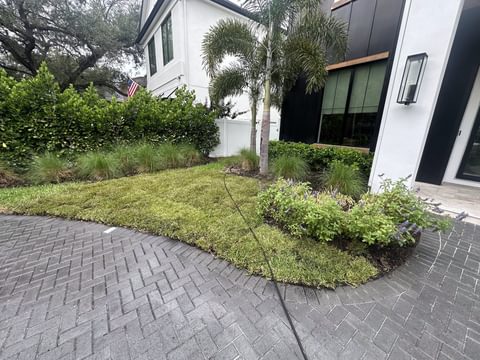
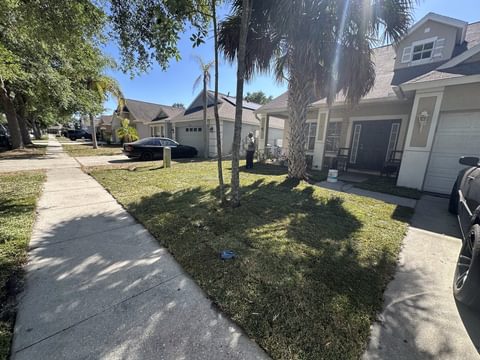
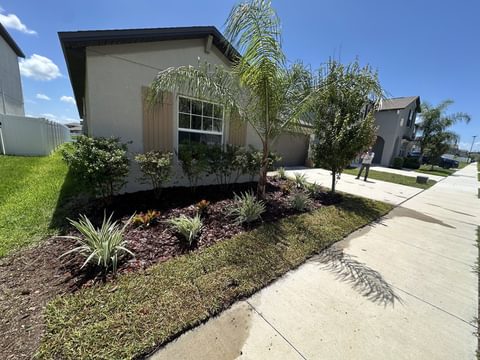
Florida-Friendly Landscaping is a UF/IFAS program built on nine principles: right plant, right place; water efficiently; fertilize appropriately; mulch; attract wildlife; manage yard pests responsibly; recycle yard waste; reduce stormwater runoff; and protect the waterfront. Under once-a-week watering, it looks like this in a Tampa Bay yard:
- Group plants by water need, and put beds on drip or micro-irrigation, which may run any day before 8 a.m. or after 6 p.m.
- Keep 2–3 inches of mulch on beds, pulled about a foot back from large trunks.
- Shrink turf in shady or hard-to-water spots and replace it with beds or groundcover.
- Use proven plants such as firebush, coontie, muhly grass, wild coffee and Simpson's stopper, with live oaks and sabal palms for shade. Check each one in the UF/IFAS Florida-Friendly plant guide for your sun and soil.
- Keep clippings, soil and fertilizer out of streets and storm drains.
Our landscape design and mulch installation work leans on these principles.
Can my HOA require a green lawn during a drought?
Generally, no. F.S. 720.3075(4) bars HOA rules that prohibit Florida-friendly landscaping or conflict with a water-shortage order, and the current Phase III order bars HOAs from enforcing rules that would increase water use. Your HOA may still require approval of landscape plans and set upkeep standards, so submit changes before you start.
Need a hand? Contact us for an irrigation check or a Florida-Friendly bed design, and read our sod guide if you're replacing turf.